

Pearls Winter 2026
Dane County Immunization Coalition Updates
Volunteers Needed!
The Dane County Immunization Coalition is always looking for volunteers to help with efforts to increase vaccination rates in our area. Opportunities include volunteering at local immunization clinics and assisting in outreach. If you are interested, please sign up here!
Upcoming Quarterly Educational Meeting
Mark your calendars! Our next quarterly educational meeting will be held virtually on Tuesday, February 17, 2026 from 12pm to 1:30pm. Watch your email in the coming weeks for the agenda which will have the Zoom link.
Quarterly Educational Meeting
A recording of our Fall 2025 meeting featuring Kara Jensen from ISMP discussing vaccination errors and how they can be prevented can be found here.
Grand Rounds
The UW Department of Pediatrics and the Dane County Immunization Coalition hosted grand rounds on Thursday, October 30, 2025 from 7:30 am to 8:30 am. This lecture featured LJ Tan from Immunize.org. discussing Advancing the Value Proposition of Adult Immunization Through Effective Implementation. View a recording here.
2026 Symposium
Save the date for our 2026 Symposium! The event will be held virtually Tuesday, April 28, 2026 from 6pm until 8:15pm. The event is free and continuing education credits will be offered.
2026 Educational Meetings
For those who like to plan ahead, the dates for our quarterly educational meetings for the rest of 2026 will be: Tuesday, February 17, Tuesday, May 19, Tuesday, August 18, and Tuesday, November 11, 2026.
Immunize Wisconsin Webinar on Shared Clinical Decision Making
Immunize Wisconsin will offer a webinar on Shared Clinical Decision Making, featuring Rajiv Naik, MD on February 12, 2026, at 12pm. This session will explore how shared decision making can strengthen clinician–patient relationships, support informed choices, and improve health outcomes. Dr. Naik will review key principles, practical approaches, and real-world examples to help clinicians effectively incorporate shared decision making into everyday practice.
Immunization Updates
American Academy of Pediatrics Issues Recommended Childhood and Adolescent Immunization Schedule for 2026
The American Academy of Pediatrics has published the “Recommended Childhood and Adolescent Immunization Schedule: United States, 2026,” that continues to recommend routine immunization for protection against 18 diseases, including RSV, hepatitis A, hepatitis B, rotavirus, influenza, and meningococcal disease.The 2026 AAP immunization schedule has been formally endorsed by 12 medical and healthcare organizations, including:
- American Academy of Family Physicians (AAFP)
- American College of Nurse Midwives (ACNM)
- American College of Obstetricians and Gynecologists (ACOG)
- American Medical Association (AMA)
- American Pharmacists Association (APhA)
- Council of Medical Specialty Societies (CMSS)
- Infectious Diseases Society of America (IDSA)
- National Association of Pediatric Nurse Practitioners (NAPNAP)
- National Medical Association (NMA)
- Pediatric Infectious Diseases Society (PIDS)
- Pediatric Pharmacy Association (PPA)
- Society for Adolescent Health and Medicine (SAHM)
Locally, the Wisconsin Department of Health Services (DHS) continues to recommend that children complete the full vaccine series according to the standard immunization schedule published by the American Academy of Pediatrics.
Declining Vaccination Rates are Driving a Rise in Whooping Cough
Whooping cough (pertussis) is reemerging across the United States as declining childhood and adolescent vaccination rates weaken community protection. Public health experts warn that reduced uptake of DTaP and Tdap vaccines, fueled by vaccine hesitancy and disruptions during the COVID-19 pandemic, has left vulnerable populations at increased risk. Given the serious risks posed by pertussis to infants, maintaining strong vaccination coverage is essential. Learn more on the Wisconsin Department of Health Services (DHS) website and see Wisconsin rates and data here.nd other adults.
Health Equity
National Minority Quality Forum offers flu training hub for pharmacists and shares two recent webinars
The National Minority Quality Forum (NMQF) is offering its Community Pharmacist Ambassador Flu Training Hub featuring updated 2025 flu education modules. These modules provide the latest information on influenza and flu vaccines, address common community questions and concerns, and highlight strategies to better support patients of color and other underserved populations.
Promoting Immunization
Promoting Flu Vaccines this Flu Season
It is not too late to vaccinate against the flu! Vaccinate Your Family is also offering its 30-minute mini-course Protecting Our Communities from the Flu which provides a clear overview of influenza and how to stay protected. The course explains how flu spreads, who is at highest risk, why some communities are disproportionately affected, and dispels common myths about flu vaccines.
The Trusted Messenger Program from the Public Good Projects offers training modules
The Trusted Messenger Program released its first module, “Maximizing Trust and Reducing Resistance.” The 1-hour module explores an evidence-based approach to address patient resistance and navigate difficult conversations. It also reviews common missteps healthcare providers may make when giving recommendations and provides tools to increase trust through good communication. CME credit is offered.
Sign up for the module to get started.
Updated 65+ Flu Defense website offers resources for healthcare professionals serving older adults
Older adults are at increased risk of severe influenza, COVID-19, and RSV illness, including hospitalization and death, especially if they are not up to date on these vaccinations. A clinician recommendation is the most important reason why a person will get vaccinated. Check out the updated 65+ Flu Defense website to assist your ongoing efforts in protecting this vulnerable population.This helpful site includes information, tools, and tips for communicating with adults age 65 and older about the burden and severity of influenza. Resources include:
- Influenza in Adults 65+: The Facts
- Influenza Vaccination: Questions Patients Aged 65 and Older Frequently Ask Their HCP
- The Importance of Preventing Influenza and COVID-19
Resources to communicate vaccine safety with patients
Immunize.org updated its handout for parents, What If You Don’t Vaccinate Your Child?, which describes the consequences of not vaccinating, and Vaccinations Are Safe: Explaining Why which explains the science underpinning today’s vaccines.
The American Academy of Pediatrics (AAP) released new Fact Checked resources to address common vaccine misconceptions with facts and supporting evidence
Boost Oregon offers motivational interviewing training
Boost Oregon is offering a variety of in-person and virtual training options to support providers in becoming proficient in motivational interviewing (MI). MI is a collaborative communication style that helps people explore their own motivations for change. Rather than relying on persuasion, MI gives providers tools to ask open-ended questions, reflect on what they hear, and guide conversations in a way that honors patients’ autonomy and values.
Boost Oregon’s MI-based training is available to healthcare and public health organizations nationwide. Sessions are flexible, ranging from short virtual introductions to multi-session, skill-building workshops, and can be tailored for a range of audiences, including nurses, pharmacists, and community health workers. Trainings are available in both English and Spanish. For public health coalitions and partner organizations, MI training offers more than a professional skillset; it’s a strategy for rebuilding trust, one conversation at a time.
In the Media
CDC Publishes Effectiveness of 2024-2025 COVID Vaccine in Children
CDC published Effectiveness of 2024–2025 COVID-19 Vaccines in Children in the United States—VISION, August 29, 2024–September 2, 2025 on December 11 in MMWR. The study found substantial benefit of COVID-19 vaccination in preventing emergency department and urgent care visits for COVID-19 illness. A portion of the summary appears below:
In June 2024, CDC’s Advisory Committee on Immunization Practices recommended 2024–2025 COVID-19 vaccination for all persons aged ≥6 months to provide additional protection against severe COVID-19. . . .
During August 29, 2024–September 2, 2025, within a multisite network including nine states, vaccine effectiveness of 2024–2025 COVID-19 vaccination was an estimated 76% against COVID-19–associated emergency department or urgent care (ED/UC) visits among immunocompetent children aged 9 months–4 years and an estimated 56% among children and adolescents aged 5–17 years, compared with those who did not receive a 2024–2025 vaccine. . . .
In a population with some persons having preexisting levels of protection from previous vaccination, previous infection, or both, 2024–2025 COVID-19 vaccination provided children with additional protection against COVID-19–associated ED/UC encounters compared with no 2024–2025 vaccination.
American Society for Meningitis Prevention shares new advocate video
The American Society for Meningitis Prevention posted a new video, The Day Kristen’s World Changed, featuring meningitis prevention advocate Kristen Aldretti. Thirty-five years ago, Kristen faced the unimaginable loss of her 20-month-old daughter, Lindsay, to meningitis B. In the video, Kristen shares her story of loss and of gratitude for vaccines that have made meningococcal meningitis preventable. Kristen hopes that by sharing her story, other parents may be less likely to experience what she did.
New film serves as cautionary tale
The Vaccine Education Center has been working with Medical History Pictures to create a new short film, Forgetting to Remember: Lessons from a Vaccine Lost. The film tells the story of the U.S. military’s experience with the adenovirus vaccine. The adenovirus vaccine is only routinely used in the military, but it serves as a cautionary tale about the importance of protecting all vaccines — at a critical time when the U.S. is poised to lose its measles elimination status.
As described in the film, the adenovirus vaccine so effectively decreased the number of cases among the troops that the military failed to provide $5 million for necessary equipment upgrades to keep producing the vaccine. As a result, the vaccine supply ran out, and adenovirus disease quickly returned. Once people realized the mistake made in allowing the vaccine to be lost, it took a decade and hundreds of millions of dollars to treat ill recruits and restore vaccine availability to again protect the troops. In the interim, eight young recruits died of adenovirus.
The adenovirus story serves as a cautionary tale when considering the current U.S. measles outbreaks, the apathy toward public health when vaccine-preventable diseases are forgotten, and the ease with which vaccines can be lost. Our ability to protect future generations against some of the worst scourges of history will depend on our ability to protect vaccines in the here and now.
Remembering the toll of infectious diseases
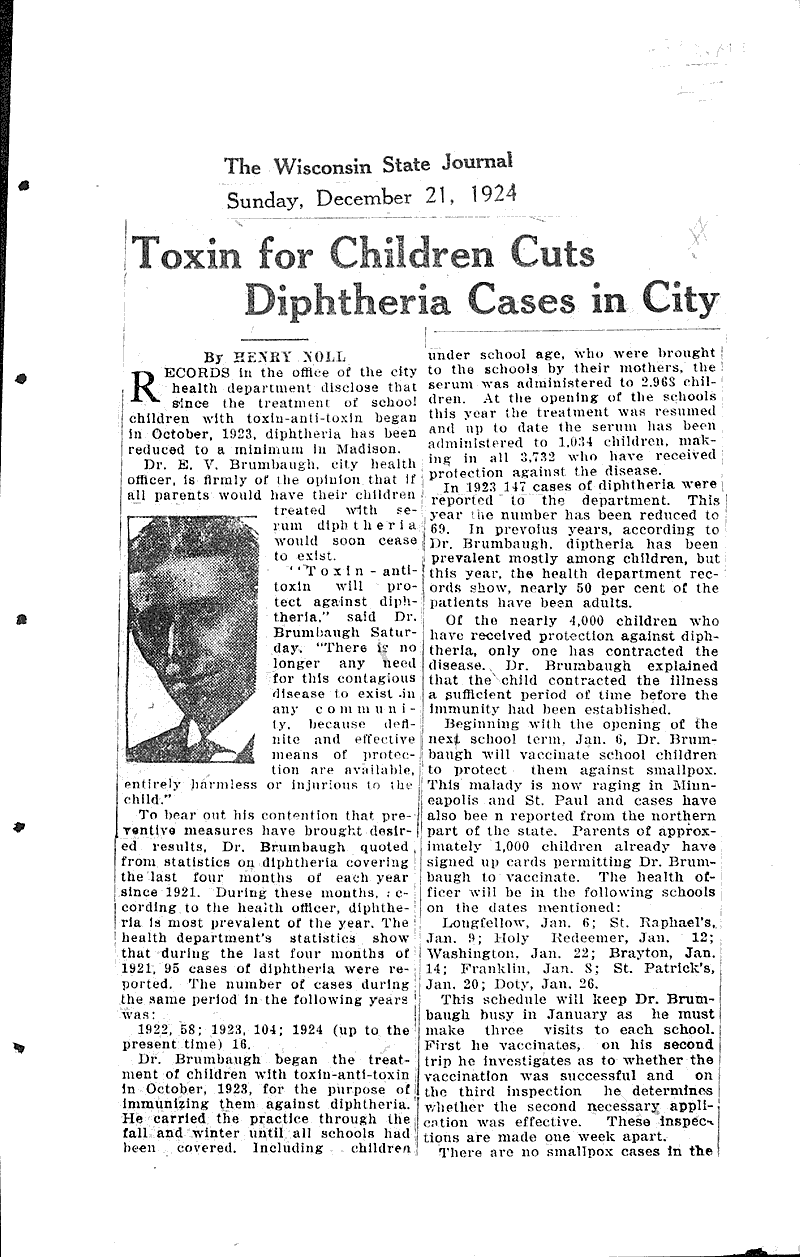
From the Wisconsin State Journal December 21, 1924
Published on Nov 19 2026
Categories: Pearls
