

Pearls Spring 2026
Dane County Immunization Coalition Updates
Volunteers Needed!
The Dane County Immunization Coalition is always looking for volunteers to help with efforts to increase vaccination rates in our area. Opportunities include volunteering at local immunization clinics and assisting in outreach. If you are interested, please sign up here!
Upcoming Quarterly Educational Meeting
Mark your calendars! Our next quarterly educational meeting will be held virtually on Tuesday, May 19, 2026 from 12pm to 1:30pm. Watch your email in the coming weeks for the agenda which will have the Zoom link.
Quarterly Educational Meeting
A recording of our Fall 2025 meeting featuring Kara Jensen from ISMP discussing vaccination errors and how they can be prevented can be found here.
2026 Symposium Recording Available
The Dane County Immunization Coalition Annual Symposium was held on Tuesday, April 28, 2026. The topics were be Cloudy With a Chance of Measles: The 2026 Vaccine Forecast and Guiding Light: Embrace Your Role in Shared Clinical Decision Making. Both were presented by Dr. James Bigham, MD, MPH, FAAFP.
To view the recording, click here.
2026 Educational Meetings
For those who like to plan ahead, the dates for our quarterly educational meetings for the rest of 2026 will be Tuesday, May 19, Tuesday, August 18 and Tuesday, November 17, 2026.
Immunize Wisconsin Webinar on Vaccine Safety
Immunize Wisconsin will offer a webinar called “Business as Usual: Reinforcing Wisconsin’s Commitment to Evidence Based Vaccine Recommendations” by Dr. Ryan Westergaard, MD, PhD, MPH on Thursday, May 14, 2026 at 12pm. Dr. Westergaard will review the principles that guide vaccine policy and implementation in Wisconsin, emphasizing continuity, scientific rigor, and public trust. Participants will gain insight into how evidence-based decision-making remains central to protecting community health and supporting clinicians, even as national and state contexts change.
State Chapter of American Families for Vaccines has Been Established in Wisconsin
American Families for Vaccines announced the creation of a new chapter of its organization—Wisconsin Families for Vaccines. The chapter will work to empower local advocates to lead the charge for stronger immunization laws and policies in the state. Those interested in working with families and advocates across the state to help advance science-based vaccine policies that protect all Wisconsinites should sign up for updates here.
Immunization Updates
2025 Wisconsin Vaccination Data Available
The Wisconsin Department of Health Services has released immunization data from 2025 showing that rates for 2 year olds continue to decline. Key points from the data:
- All vaccination rates assessed for 24-month-olds decreased from 2024 to 2025. The majority of the rates decreased by approximately 2%.
- 1 dose of MMR decreased by 1.6% and completion of the child series (4:3:1:3:3:1:4 series) decreased by 1.9%.
- 1 dose of hepatitis A vaccine decreased by 2.1% but 2 doses only decreased by 0.1%.
- DTaP(4) and Polio(3) decreased by 1.8%. PCV(4) and HepB(3) decreased by 1.9%. Varicella(1) decreased by 2%, and Hib(3) by 2.1%
- Two measures for adolescents had minor decreases from 2024 to 2025. 1 dose of HPV for 13–18-year-olds decreased by 0.3% and 1 dose of Tdap for 13–18-year-olds decreased by 0.5%.
- Two measures for adolescents saw increases greater than 1%:
- Completion of the meningococcal ACWY vaccine series in 17–18-year-olds increased by 2.7%. This follows an increase of 5.4% in 2024 and a new requirement in the 2024–2025 school year for a MenACWY containing vaccine booster dose for eligible students entering 7th and12th grade.
- 1 dose of the meningococcal B vaccine in 18-year-olds increased by 6.6% from 22.6% in 2024 to 29.1% in 2025.
- There were no decreases in any vaccination rates for adults.
Federal Court Stays All ACIP and Immunization Policy Changes from 2025 and 2026
In March a federal judge ruled that the changes made to the Advisory Committee on Immunization Practices (ACIP) violated federal law and stayed all of their votes on vaccine policy. The ruling also overturns the revised vaccine schedule (the so-called “Denmark Schedule”) proposed by the Department of Health and Human Services in early 2026. Providers should continue to follow the American Academy of Pediatrics’ “Recommended Childhood and Adolescent Immunization Schedule: United States, 2026,” for children that recommends routine immunization for protection against 18 diseases, including RSV, hepatitis A, hepatitis B, rotavirus, influenza, and meningococcal disease. The American College of Obstetrics & Gynecology and the American Academy of Family Physicians should be referenced for immunization guidance of pregnant persons and other adults.
Health Equity
ACOG Releases Updated Guidance on Maternal Immunizations
ACOG has released updated guidance on maternal immunizations, underscoring the importance of vaccines in protecting pregnant women and their infants. The guidance urges ob-gyns to routinely review patients’ immunization status and recommend needed vaccines. It also addresses barriers to vaccination, including misinformation and long-standing mistrust of the medical system, especially in communities of color that have faced systemic racism throughout history and continue to do so today. A social media toolkit is available as well as resources in Spanish.
Promoting Immunization
Immunize.org has Resources to Reduce Needle Anxiety and Improve the Vaccination Experience
Immunize.org has resources to improve the vaccination experience, including print and video tools to create a positive vaccination experience and ease injection anxiety in children and adults. Links to additional resources from trusted partner organizations are also provided. The resources include tips for patients and healthcare professionals to vaccine anxiety in patients of all ages.
Immunize.org updates “Adult Immunization: Importance of Staying Up to Date with Vaccines”
Immunize.org updated its patient resource, Adult Immunization: Importance of Staying Up to Date with Vaccines. This 1-page document describes the reasons adults need to be vaccinated. Changes include updated references, statistics, and links to the American Academy of Family Physicians and Vaccinate Your Family.
Communication can Increase Vaccine Confidence
An article from Pharmacy Times outlines communication strategies that healthcare providers can use with their patients to increase confidence in vaccines, including:
- Adopting engaging, bidirectional communication strategies to effectively address vaccine hesitancy and enhance patient confidence in vaccinations.
- Trustworthiness in messaging requires a balance of competence, integrity, and caring, beyond mere medical expertise and facts.
- Motivational interviewing, a patient-centered communication style, enhances patients’ motivation to change behaviors, improving vaccine uptake.
- Tailored, empathetic communication solidifies pharmacists’ roles as trustworthy messengers, maximizing vaccine uptake.
In the Media
In the Media
“COVID-19 Vaccine Framing and Acceptance Among Adults Who Are Vaccine Hesitant” published in JAMA
In its March 31 issue, JAMA published COVID-19 Vaccine Framing and Acceptance Among Adults Who Are Vaccine Hesitant. The study found that more vaccine-hesitant older adults were willing to accept hypothetical COVID shots when vaccination was described as a way to preserve their freedom and autonomy rather than as an action that complies with government recommendations.
In this cross-sectional study using a discrete choice experiment among 907 adults in the US, freedom framing compared with government recommendation framing was associated with substantial preference shifts among respondents expressing vaccine concerns or endorsing adverse beliefs about COVID-19 vaccines, with no such association among respondents with low vaccine concerns.
“Communicating About Vaccines in a Politically Contentious Climate” published in NEJM
In its March 21 issue, NEJM published Communicating About Vaccines in a Politically Contentious Climate.
Given the multitude of federal vaccine policy changes and the historical and anticipated struggles in communicating with parents about vaccines with an SDM [shared decision-making] recommendation, clinicians may find these conversations increasingly difficult. In this context, it may be helpful to remember what has remained constant: pediatric clinicians have been and continue to be parents’ most trusted source of reliable information about vaccines. It is important that clinicians both draw on this trust and nurture it.
Remembering the toll of infectious diseases
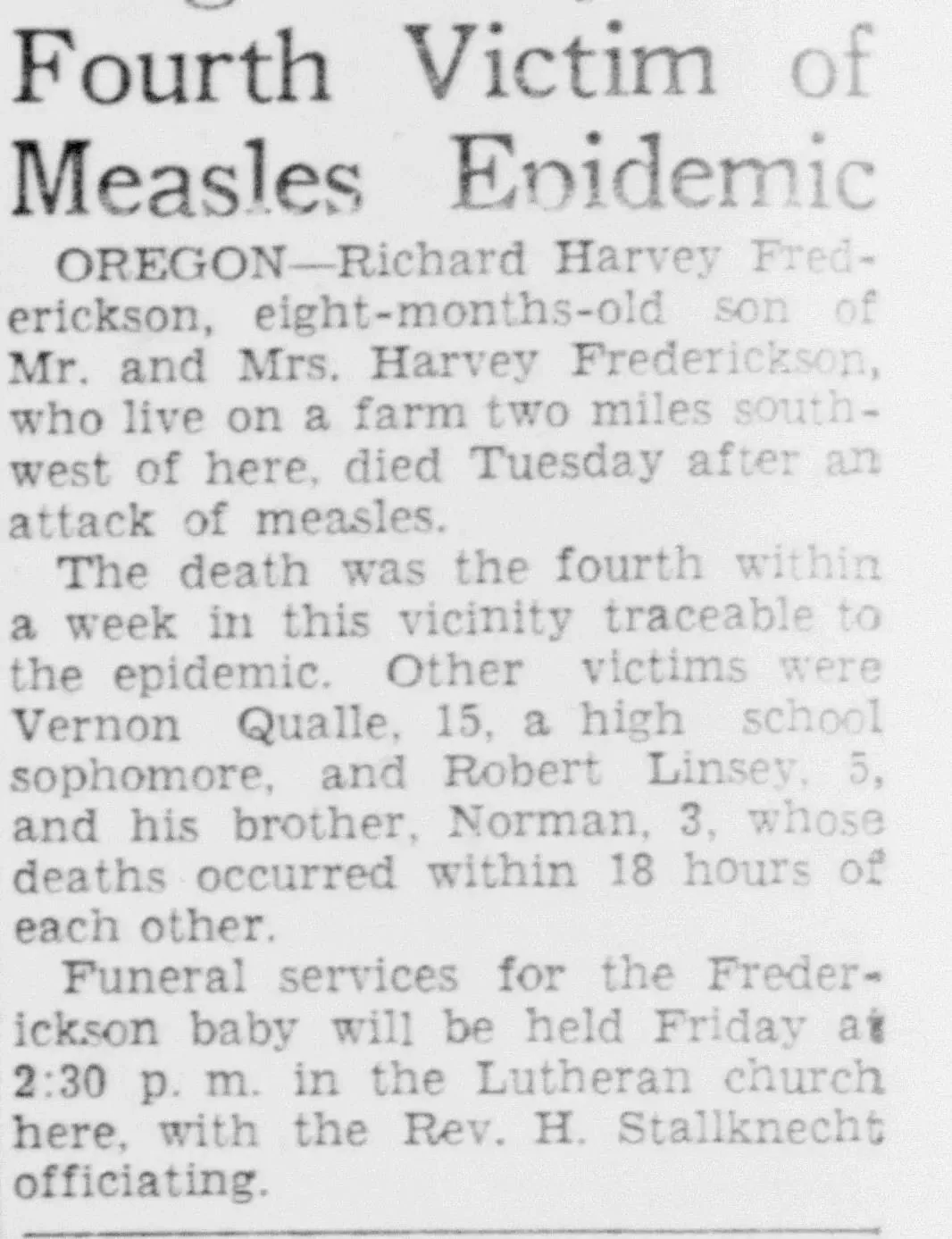
From the Wisconsin State Journal May 22, 1935
Published on Nov 19 2026
Categories: Pearls
